
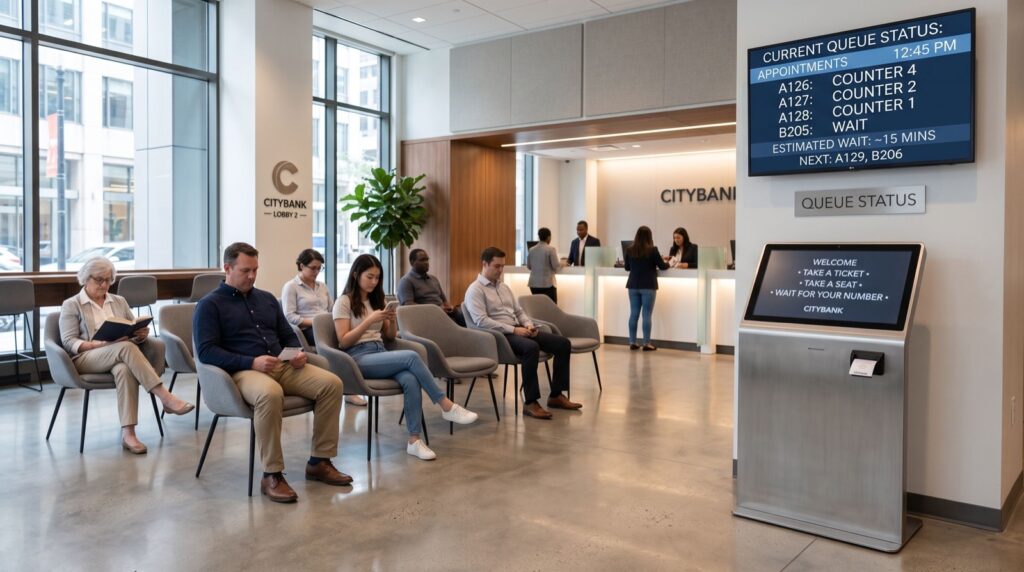
Queue Management System in Lahore: 7 Industries That Benefit
Lahore’s fast-growing service economy runs on face-to-face interactions, and that means queues. From packed hospital reception halls to bustling telecom franchises, waiting lines are everywhere. A well-designed queue management system in lahore replaces that daily chaos with smooth, trackable service flow. This 2026 guide takes an industry-by-industry look at who benefits most and why.
Why Lahore Needs Smart Queuing in 2026
As Lahore’s population and commercial activity expand, so does foot traffic at service points. Traditional lines simply do not scale. They crowd lobbies, frustrate visitors, and leave managers blind to what is actually happening at the counter.
Digital queuing changes the equation. Visitors join a virtual line, wait wherever they like, and get called fairly. Managers gain live data to staff smarter. The result is faster service and a calmer, more professional environment.
7 Industries That Gain the Most
While almost any service business benefits, seven sectors in Lahore see the strongest, fastest returns, from banks to contact centers.
1. Banking and Finance
Banks juggle quick transactions and complex account services. Smart routing separates the two, so a simple deposit never sits behind a long consultation.
2. Healthcare and Hospitals
Clinics and hospitals reduce overcrowded waiting rooms and calm anxious patients by letting them wait from a seat or their phone rather than a crowded corridor.
3. Telecom and Franchises
Telecom outlets handle SIM services, bill payments, and device support. Categorized queues speed each visit and cut abandonment.
4. Government and Public Services
One-stop service centers process high volumes of diverse requests. Queuing keeps them orderly and transparent, improving public trust.
5. Retail and Showrooms
High-value showrooms use appointment-plus-walk-in queuing so premium customers get attentive, unhurried service.
6. Education and Admissions
Universities and colleges manage admission rushes and fee counters far more smoothly with digital tickets and SMS alerts.
7. Contact Centers and Support Desks
Support desks tied to your branches live on clear audio. A quality agent headset like the Addasound Epic 301 keeps every customer call crisp, which shortens each interaction and keeps the connected queue moving.
Feature Priorities by Industry
| Industry | Top Feature Need | Secondary Need |
|---|---|---|
| Banking | Service-type routing | Multi-branch analytics |
| Healthcare | SMS notifications | Appointment integration |
| Telecom | Categorized queues | Feedback capture |
| Government | High-volume handling | Bilingual display |
| Retail | Appointment + walk-in | Staff productivity data |
| Education | Peak-load management | Mobile check-in |
| Contact Center | Clear agent audio | Call handling time data |
What Should Lahore Businesses Look For in a Vendor?
The software is only half the story. The vendor and their local support determine whether your rollout succeeds. Evaluate candidates against this checklist.
- Local presence: On-ground support in Lahore for fast installation and repairs.
- Bilingual capability: Full Urdu and English interfaces and announcements.
- Scalability: Room to add counters and branches without reinstalling.
- Integration: Open APIs for CRM and appointment systems.
- Reliable hardware: Commercial-grade kiosks and displays built for heavy use.
Choosing trusted professionals for design and installation protects your budget and shortens time to results.
Measuring Success After Deployment
Once live, track the right metrics to prove and grow your return. Focus on these four.
- Average wait time: The headline number visitors feel most.
- Service time per counter: Reveals training or staffing gaps.
- No-show and abandonment rate: Often the biggest hidden loss.
- Customer satisfaction score: Captured through quick post-service ratings.
Here is an original, field-tested tip: correlate satisfaction scores with specific time slots, not just averages. You may discover that satisfaction craters only during the after-lunch rush, which points to a precise staffing fix rather than a vague, expensive overhaul.
The broader case for digitizing service delivery is well documented. The International Telecommunication Union highlights how digital service tools improve access, efficiency, and satisfaction across public and private sectors, principles that map directly onto queue automation in a growing city like Lahore.
Overcoming Common Objections in Lahore
Decision-makers often hesitate before adopting queuing technology. The objections are predictable, and each has a clear answer grounded in real deployments across the city.
The first objection is cost. Owners worry that queuing hardware and software are luxuries. In practice, even a modest system pays back quickly by reducing walkaways and freeing staff to serve more visitors per hour. When you count the revenue lost to customers who abandon a long line, the investment usually looks conservative rather than extravagant.
The second objection is complexity. Managers fear a difficult rollout that disrupts daily operations. A phased pilot at a single branch, run during a genuine peak period, removes this risk. Staff learn the workflow on a small scale before it spreads network-wide, and any rough edges surface early when they are cheap to fix.
The third objection is staff resistance. Counter teams sometimes see new technology as surveillance. The remedy is framing and training. Position the analytics as a tool that protects staff from unfair blame during rushes and highlights genuine top performers. When teams understand the data works for them, adoption accelerates.
A Quick Note on Maintenance
Hardware in a busy Lahore service center endures heavy daily use. Schedule preventive checks on kiosks, screens, and audio peripherals, and keep spare consumables on hand. A short quarterly maintenance routine prevents the small failures that otherwise erode trust in the system over time.
Frequently Asked Questions
Which industry benefits most from a queue management system in Lahore?
Banking, healthcare, and telecom typically see the fastest returns because they handle high volumes of varied service types where smart routing and notifications make an immediate difference.
Can small businesses in Lahore afford a queue system?
Yes. Entry-level configurations with a single kiosk and display are affordable and can scale later. You pay for the tier that matches your current foot traffic.
How long does installation take in Lahore?
A single location often goes live within a few days once hardware arrives. Larger multi-branch deployments with integrations take a few weeks including staff training.
Does the system need constant internet connectivity?
Most systems run locally at the branch and sync analytics to the cloud. Core queuing continues to work even during brief connectivity interruptions.
Conclusion
A queue management system in Lahore delivers measurable value across banking, healthcare, telecom, government, retail, education, and contact centers. By matching features to your industry, choosing a vendor with strong local support, and tracking the right metrics after launch, your organization can cut waits, lift satisfaction, and operate more efficiently in 2026. Request a demo, run a focused pilot, and let trusted specialists build a solution around your service goals.