
Behind every well-stocked shelf and every order that ships on time sits a warehouse most customers never think about. For wholesalers and retailers across Saudi Arabia, that unseen space is where profit is quietly won or lost. Buy well but store badly, and the savings vanish into spoilage, misplaced pallets, and stockouts. Store well, and inventory becomes an asset that moves smoothly from supplier to customer without friction.
This article is written for the trade: the importers, distributors, and shop-owners who deal in volume and depend on storage to hold their business together. It looks at how warehousing supports the buy-and-sell model, why temperature-controlled space is increasingly central even for goods that seem shelf-stable, and how to structure your storage so it scales with your ambitions instead of throttling them.
The Warehouse as a Profit Center, Not a Cost
Many merchants treat storage as pure overhead, a line item to minimize. That framing misses the point. A warehouse that keeps stock in good condition, retrievable in seconds, and accurately counted is directly protecting your margin and your customer relationships. Poor storage, by contrast, taxes the business invisibly through damaged goods, slow picking, and the chaos of not knowing what you actually have.
Seen properly, storage is where inventory strategy meets execution. The buyer who secures a container at a good price still needs somewhere to hold it that does not erode the advantage. That is why smart operators think about warehousing as an extension of their commercial edge rather than a necessary expense to squeeze.
Storage Built Around How the Trade Actually Works
Wholesale and retail have storage needs that differ from a single manufacturer’s. Volumes swing with seasons and promotions, stock arrives in bulk but leaves in smaller pick-and-pack quantities, and the mix of goods can be enormously varied. Purpose-built Storage for Wholesalers and Retailers is designed around exactly this rhythm, offering the pallet-in, carton-out flexibility that the trade lives by.
The practical benefits show up in daily operations. Bulk inbound shipments get received and put away efficiently, individual orders get picked without tearing apart the whole layout, and returns get processed without clogging the floor. A warehouse tuned to trade patterns lets a distributor say yes to more orders without drowning in its own inventory.
Why Temperature Control Reaches Further Than You Think
It is easy to assume only obvious perishables need conditioned storage. In the Saudi climate, that assumption costs money. Cosmetics separate and degrade in heat, chocolate and confectionery bloom and melt, certain packaged foods spoil faster, and even some electronics and medicines that a retailer stocks quietly demand cool, stable conditions. The line between shelf-stable and temperature-sensitive is blurrier than most catalogs suggest.
For a mixed retailer or wholesaler, this means storage planning has to account for the fussiest items in the range, not just the average. Getting this wrong shows up as returns, complaints, and write-offs on products nobody expected to fail. Getting it right means a broader, more valuable product mix stays saleable all the way to the customer.
Frozen Capacity as a Growth Lever
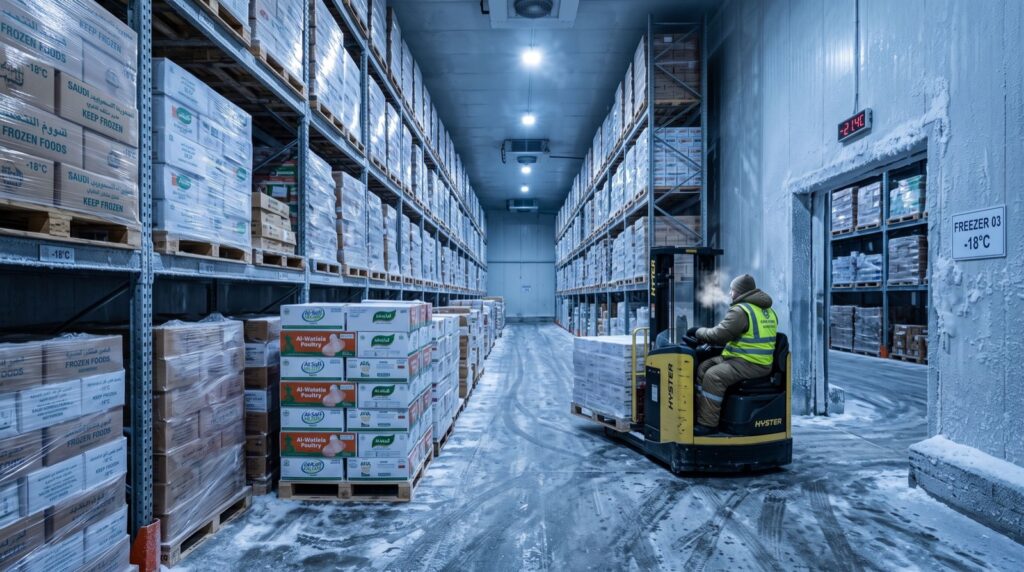
For traders willing to move into frozen categories, the reward is a market with strong, steady demand and less competition from operators who lack the infrastructure. Access to reliable Frozen Storage in Dammam lets a distributor add frozen meat, seafood, or ready meals to the catalog without the enormous capital cost of building and running deep-freeze capacity in-house.
Frozen goods are unforgiving, so this is a category where partnering with the right facility matters most. The warehouse must hold deep temperatures without drift, recover quickly after every door opening, and document the cold chain end to end. When a trader can rely on that backbone, frozen becomes a profitable line rather than a liability, opening doors to food-service and retail customers who need a supplier they can trust.
Accuracy, Visibility, and the Cost of Guesswork
Nothing drains a trading business quite like not knowing what it owns. Overstock ties up cash in goods that sit unsold; understock means turning away orders you could have filled. Modern warehousing closes this gap with real inventory systems that track every unit in and out, giving the merchant a live, accurate picture rather than a monthly guess.
Working with an experienced local team that understands both the software and the floor makes this visibility real rather than theoretical. Numbers on a screen only help if they match the pallets on the racks, and that alignment comes from disciplined receiving, putaway, and picking done by people who know the trade.
What to Verify Before You Sign
Choosing a storage partner is a decision you will live with daily, so it pays to check the fundamentals before committing volume. The items below separate a facility that will support your growth from one that will become a bottleneck.
- Flexible pallet and space contracts that scale up and down with your seasonal volume.
- Multiple temperature zones so ambient, chilled, and frozen goods can all live under one roof.
- Accurate, transparent inventory systems you can access without phoning for updates.
- Efficient inbound and outbound handling that supports both bulk receiving and small-order picking.
- Documented hygiene, security, and pest control appropriate for food and consumer goods.
A facility that meets these confidently is one you can build a business on; one that hedges on them is a risk waiting to surface at your busiest moment.
Scaling Without Overbuilding
The classic trap for a growing trader is committing to fixed storage capacity, either too much or too little. Build your own warehouse and you carry the cost of empty space in quiet months; rent too small and you strangle your own growth. Third-party storage sidesteps both problems by letting you rent the capacity you need as you need it, converting a heavy fixed cost into a flexible operating one.
This flexibility is especially valuable in a market where demand moves with seasons, holidays, and promotions. Instead of planning your business around your warehouse, you let the warehouse flex around your business, adding positions for a peak and releasing them when the rush passes.
Key Takeaways
- Treat warehousing as a profit center that protects margin, not merely an expense to cut.
- Trade-focused storage handles bulk inbound and small-order outbound in the same flexible space.
- More goods than you expect need temperature control in the Saudi climate; plan for the fussiest.
- Access to frozen capacity opens profitable categories without in-house capital cost.
- Accurate inventory visibility and flexible contracts let you scale without overbuilding.
Turning Storage Into a Competitive Edge
For wholesalers and retailers, the warehouse is far more than a place to park boxes. It is where inventory strategy becomes daily reality, where margins are defended, and where the ability to say yes to a big order is either supported or sabotaged. The traders who thrive treat storage as a lever, choosing partners who offer the temperature control, accuracy, and flexibility their goods and their growth demand. Get that foundation right, and everything downstream, from pricing to customer trust, gets easier to manage.